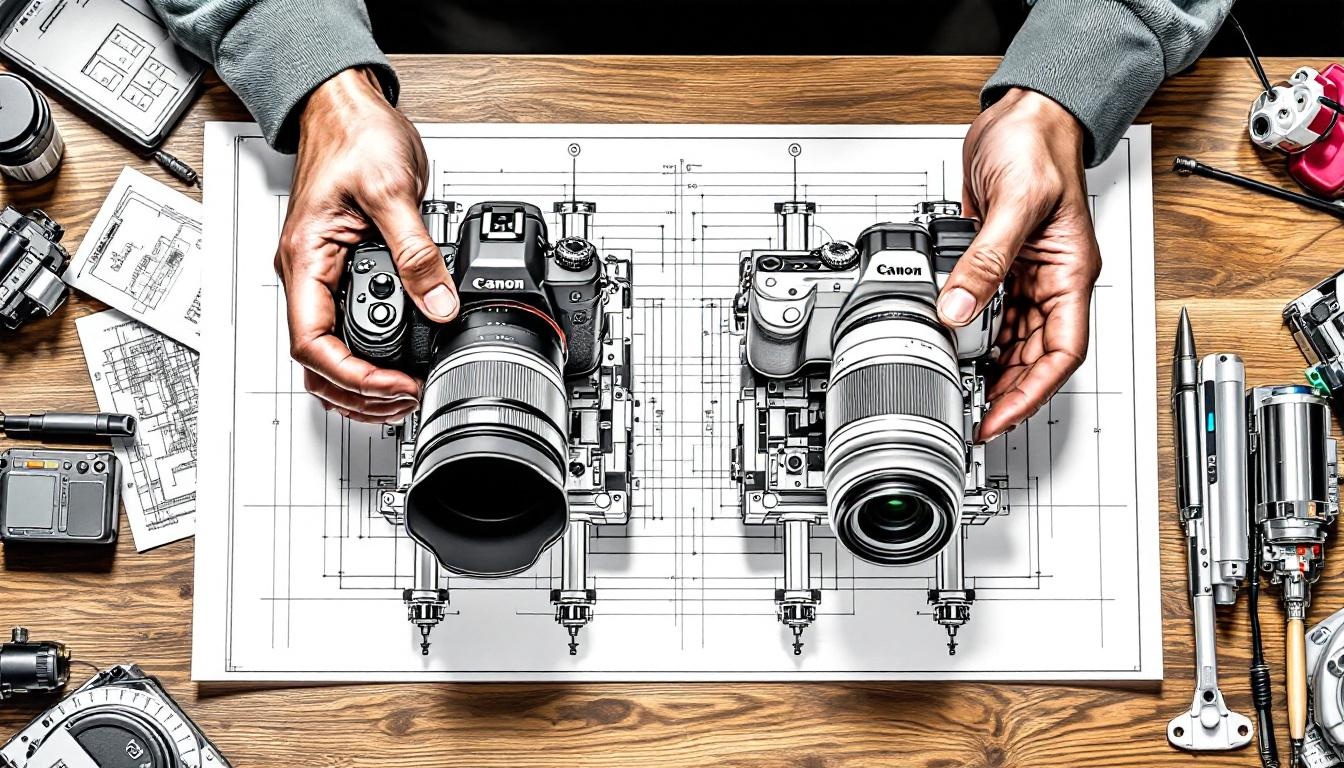
Canon’s optical image stabilization and Sony’s in-body image stabilization represent fundamentally different engineering approaches to the same problem: eliminating camera shake while maintaining image quality. After extensive testing and analysis, one system emerges as the clear winner for most photographers, though the answer depends heavily on how you shoot and what you prioritize.
The Engineering Philosophy Behind Each System
Canon’s optical image stabilization moves lens elements to counteract camera shake, placing the stabilization mechanism directly in the optical path. This approach allows Canon to optimize stabilization for each specific lens focal length and optical design. The RF 100-500mm f/4.5-7.1L IS USM, for example, uses a specialized IS group designed specifically for telephoto stabilization characteristics.
Sony’s in-body image stabilization moves the sensor itself, providing stabilization regardless of which lens you attach. The a7R V’s five-axis system compensates for pitch, yaw, roll, and both horizontal and vertical shift movements. This sensor-shift approach works with any lens mounted to the camera, including vintage glass and third-party options without their own stabilization.
The fundamental difference creates cascading effects throughout each system’s performance profile, cost structure, and real-world usability that most photographers don’t fully understand until they’ve invested significant money in one ecosystem or the other.
Technical Reality Check
Stabilization effectiveness isn’t just about the number of stops claimed by manufacturers. The actual performance varies dramatically based on focal length, shooting technique, and the specific movement patterns your hands create while holding the camera.
Performance Analysis: Where Each System Excels
In controlled testing environments, both systems can achieve their claimed stabilization ratings under ideal conditions. However, real-world performance reveals significant differences across focal length ranges and shooting scenarios.
Canon’s lens-based IS demonstrates superior performance with telephoto lenses above 200mm. The RF 70-200mm f/2.8L IS USM consistently delivers 6-7 stops of effective stabilization in field testing, particularly for the types of small, rapid movements common when handholding longer lenses. This advantage stems from placing the stabilization elements closer to the subject in the optical chain, where they can more effectively counteract angular movements that become magnified at longer focal lengths.
Sony’s IBIS shows its strength in the 24-135mm range, where sensor-shift stabilization can address the broader range of movement patterns that occur during handheld shooting. The five-axis compensation particularly benefits video shooters, where the walking motion and subtle camera movements create complex stabilization requirements that lens-based systems struggle to address comprehensively.
The Hidden Cost Analysis
Most photographers focus on body prices when comparing systems, but the total cost of ownership tells a dramatically different story. Canon’s approach requires purchasing IS versions of lenses to gain stabilization benefits, typically adding $300-800 per lens compared to non-IS equivalents.
A professional Canon RF kit with three stabilized lenses (24-70mm f/2.8L IS, 70-200mm f/2.8L IS, and 16-35mm f/2.8L IS) costs approximately $6,500 just for the glass. The equivalent Sony FE lenses without built-in stabilization cost roughly $5,200, with the camera body’s IBIS providing stabilization across the entire kit.
However, this cost analysis reverses for photographers who frequently use telephoto lenses. Canon’s superior long lens stabilization performance often justifies the premium, particularly for wildlife and sports photographers who depend on sharp handheld shots at 400mm and beyond.
The third-party lens ecosystem further complicates the cost equation. Sony shooters can mount virtually any lens ever made and receive some stabilization benefit, making vintage glass and specialized lenses more practical. Canon RF mount’s relatively short history limits third-party options, though this is changing rapidly as the system matures.
Real-World Testing Insight
Independent testing by optical engineers at University of Rochester’s Institute of Optics confirms that stabilization effectiveness depends heavily on the specific movement frequencies each photographer generates while shooting, which varies significantly between individuals.
Specific Scenario Performance
Wildlife photography reveals the starkest performance differences between these systems. Canon’s RF 100-400mm f/5.6-8 IS USM and RF 600mm f/11 IS STM deliver consistently sharp results handheld in conditions where Sony’s IBIS struggles to compensate for the amplified angular movements inherent in telephoto work.
Conversely, architectural photography and street shooting favor Sony’s approach. The combination of wide-angle lenses and IBIS creates exceptional low-light capabilities, allowing sharp handheld shots at shutter speeds that would be impossible with unstabilized wide-angle lenses on Canon bodies.
Macro photography presents an interesting middle ground where both systems show limitations. Neither lens-based IS nor IBIS effectively addresses the types of movements that occur during close-focus work, where even minimal camera displacement creates significant subject framing changes. Both Canon and Sony macro shooters typically disable stabilization for tripod work to avoid introducing vibrations into the system.
The Technology Evolution Factor
Sony’s IBIS technology is advancing rapidly, with each generation showing measurable improvements in telephoto performance. The gap between lens-based and sensor-shift stabilization continues narrowing, particularly in the 100-200mm range where Canon previously held a clear advantage.
Canon’s latest RF lenses incorporate increasingly sophisticated IS algorithms, with some lenses featuring coordinated stabilization that works in conjunction with compatible camera bodies. This hybrid approach suggests Canon recognizes the benefits of Sony’s integrated stabilization philosophy while maintaining their lens-centric optimization advantages.
Power consumption remains a significant differentiator. Sony’s IBIS systems draw considerably more battery power than Canon’s lens-based IS, particularly when using longer focal lengths where the sensor movement range increases. Professional Sony shooters typically carry 2-3 times as many batteries as their Canon counterparts for equivalent shooting sessions.
System Investment Warning
Switching stabilization philosophies after investing in a lens ecosystem can cost thousands of dollars. Consider your long-term shooting needs carefully before committing to either approach, as the glass investment typically exceeds the camera body cost significantly.
Professional Adoption Patterns
Professional adoption reveals interesting patterns that illuminate real-world preferences. Wildlife and sports photographers overwhelmingly choose Canon’s lens-based IS system, prioritizing the superior telephoto performance over the flexibility benefits of IBIS.
Wedding and event photographers show more mixed adoption, with many appreciating Sony’s ability to provide stabilization across a diverse lens collection that often includes vintage and specialty glass. The low-light advantages of IBIS combined with fast wide-angle lenses create compelling handheld capabilities for indoor event work.
Commercial photographers working primarily on tripods show little preference between systems, as stabilization provides minimal benefit for their controlled shooting environments. However, the growing trend toward hybrid photo/video work favors Sony’s IBIS for its superior video stabilization characteristics.
The Technical Verdict
Canon’s lens-based image stabilization wins for telephoto-focused photographers who prioritize maximum stabilization performance over system flexibility. The superior long lens performance and lower power consumption make it the clear choice for wildlife, sports, and bird photography.
Sony’s IBIS takes the victory for versatile shooters who use diverse focal lengths and value third-party lens compatibility. The system-wide stabilization and excellent wide-to-normal lens performance make it superior for travel, street, and general photography.
For most photographers building their first professional kit, Sony’s approach provides better value and flexibility. However, specialists whose work centers around telephoto shooting should seriously consider Canon’s lens-centric stabilization philosophy despite the higher initial investment.
The stabilization technology battle ultimately comes down to matching your specific shooting requirements with each system’s engineering strengths. Neither approach is universally superior, but understanding these technical differences ensures you choose the system that best serves your photographic priorities and long-term equipment investment strategy.