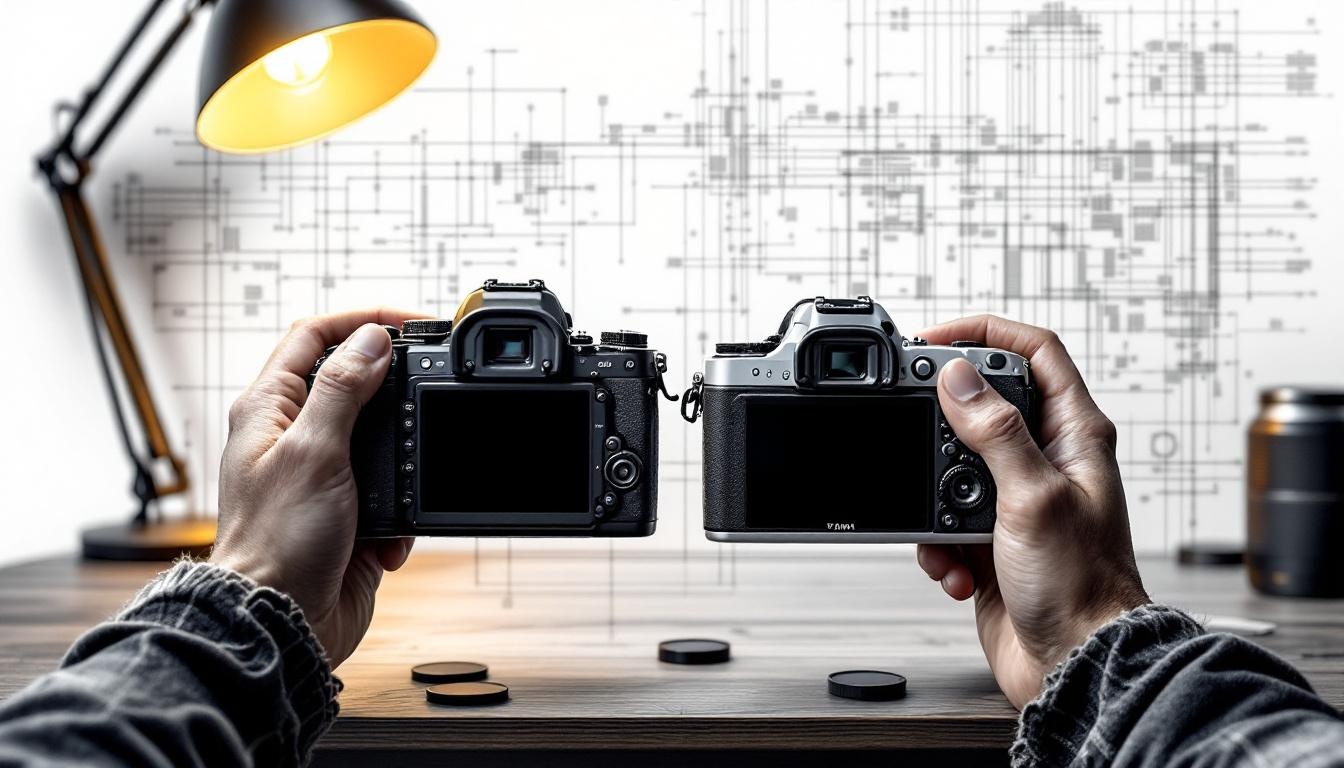
Camera manufacturers face an engineering paradox: every megapixel added to a sensor creates exponentially more data to process, while every frame per second demanded requires faster data throughput. This fundamental tension shapes every camera body design decision and should drive your purchasing priorities.
The relationship between resolution and speed isn’t just about marketing specifications. It involves measurable physics constraints in sensor readout speeds, processing chip capabilities, and memory buffer architectures that create real performance bottlenecks.
The Physics of the Speed-Resolution Trade-off
Sensor readout speed creates the primary bottleneck in camera performance. High-resolution sensors require more time to read pixel data from the sensor to the processing chip. A 45-megapixel sensor needs to transfer roughly three times more data than a 16-megapixel sensor for each frame, directly limiting maximum frame rates.
Back-illuminated (BSI) sensor technology and stacked sensor designs attempt to overcome these limitations. Sony’s stacked CMOS sensors place memory directly behind the photodiodes, reducing data transfer distances. Canon’s dual-pixel architecture reads sensor data through parallel pathways. However, these technologies add significant cost and still cannot eliminate the fundamental data processing constraints.
Processing power compounds the challenge. Camera bodies use dedicated image processors (like Canon’s DIGIC series or Sony’s BIONZ processors) that must handle demosaicing, noise reduction, and compression in real time. Higher resolution images require more processing cycles per frame, creating another bottleneck that limits continuous shooting speeds.
Critical Specification
Buffer depth specifications often mislead buyers. A camera advertising “200 JPEG buffer” may drop to 15-20 RAW files at full resolution. Check RAW buffer capacity at your intended resolution and shooting speed before purchase.
Sensor Format Impact on Resolution Requirements
Crop factor fundamentally changes resolution calculations for equivalent image quality. A 24-megapixel full-frame sensor provides approximately 6000×4000 pixel resolution. An APS-C sensor needs roughly 38 megapixels to match this pixel density, while Micro Four Thirds requires about 54 megapixels for equivalent detail capture per unit area.
This relationship affects lens selection requirements. High-resolution sensors magnify lens optical limitations. A 61-megapixel full-frame sensor can reveal chromatic aberration and resolution limits in lenses that appear sharp on 24-megapixel bodies. New Flash Sync Speed Regulations: What They Mean for High-Speed Photography becomes crucial when pairing ultra-high resolution bodies with existing lens collections.
Manufacturers design sensor technology around these constraints. Fujifilm’s X-Trans sensor design attempts to eliminate anti-aliasing filters while maintaining high resolution. Phase One’s medium format sensors prioritize maximum resolution over speed for technical photography applications.
Memory Card and Buffer Architecture
Memory card specifications create real-world performance bottlenecks that specifications sheets often obscure. CFexpress Type B cards theoretically support 1700MB/s write speeds, but many camera bodies cannot utilize this full bandwidth due to internal bus limitations.
Buffer architecture varies significantly between manufacturers. Canon’s latest bodies use separate buffers for RAW and JPEG processing. Sony implements unified buffer systems that dynamically allocate memory based on file types. These design differences create substantially different real-world shooting experiences even with identical megapixel counts and advertised frame rates.
Temperature management affects sustained performance. High-resolution, high-speed shooting generates significant heat in both sensors and processors. Many camera bodies implement thermal throttling that reduces frame rates or temporarily disables shooting when internal temperatures exceed safe operating limits.
- Maximum detail capture for large prints
- Extensive cropping capabilities
- Future-proof image archives
- Limited continuous shooting speeds
- Larger file storage requirements
- Higher lens quality demands
- High frame rates for action capture
- Faster autofocus tracking
- Better low-light performance
- Limited cropping flexibility
- Lower maximum print sizes
- Reduced detail for technical work
Low Light Performance and Pixel Density
Pixel density directly affects low-light performance through basic physics principles. Smaller pixels collect less light than larger pixels, requiring higher ISO sensitivity to achieve equivalent exposures. This relationship means that 45-megapixel full-frame sensors typically show more noise at high ISO settings than 12-megapixel sensors of the same generation.
Modern sensor technology attempts to mitigate these limitations through improved microlens design and back-side illumination architecture. However, the fundamental relationship between pixel size and light-gathering capability cannot be eliminated through processing algorithms alone.
Manufacturers implement different approaches to balance resolution and low-light performance. Sony’s A7R series provides pixel binning modes that combine adjacent pixels for improved low-light sensitivity while reducing effective resolution. Canon’s dual-pixel architecture provides some noise reduction benefits through spatial correlation processing.
Technical Reality Check
Pixel-level sharpness requires significantly higher shutter speeds on high-resolution sensors. Camera shake that appears acceptable on 24MP bodies becomes visible pixel-level blur on 61MP sensors, often requiring shutter speeds 1.5-2 stops faster for equivalent sharpness.
Specific Technical Specifications to Evaluate
When comparing camera bodies, several technical specifications provide objective measures of resolution versus speed capabilities. Sensor readout speed, measured in milliseconds for full-frame capture, directly indicates maximum frame rate potential before electronic shutter artifacts appear.
Rolling shutter performance varies dramatically between sensor designs. DXOMark’s sensor testing provides standardized measurements of rolling shutter speeds across different camera models, enabling direct technical comparisons.
Autofocus system specifications affect both resolution and speed priorities differently. Phase detection autofocus points require dedicated sensor real estate that reduces light-gathering area. The density and coverage area of autofocus points create measurable impacts on both image quality and tracking performance.
Dynamic range specifications, measured in stops of latitude, often correlate inversely with maximum frame rates due to analog-to-digital converter limitations. Cameras optimized for high dynamic range typically sacrifice some high-speed performance for improved tone mapping capabilities.
Manufacturer-Specific Technologies
Each major manufacturer implements different technical approaches to balance resolution and speed constraints. Canon’s dual-pixel CMOS technology places phase detection elements at every pixel location, providing autofocus advantages but requiring additional processing overhead that can limit frame rates.
Sony’s stacked sensor design in bodies like the A9 series places DRAM memory directly integrated with the sensor chip, enabling much faster readout speeds. This technology allows moderate resolution (24MP) sensors to achieve exceptional frame rates (20fps) while maintaining full autofocus tracking.
Nikon’s implementation focuses on processing efficiency rather than sensor architecture innovations. Their EXPEED processors prioritize sustained shooting performance over peak frame rates, providing more consistent buffer clearing and thermal management.
The ISO technical committee standards for digital camera specifications provide frameworks for comparing these different approaches objectively, though manufacturers often implement proprietary extensions beyond these baseline standards.
Future Technology Considerations
Emerging sensor technologies will continue reshaping the resolution versus speed equation. Global shutter sensors eliminate rolling shutter artifacts entirely but currently require significant compromises in pixel density and manufacturing costs.
Computational photography techniques increasingly supplement pure sensor capabilities. Multi-frame noise reduction, focus stacking, and resolution enhancement through sensor shift technology can provide some benefits of both high resolution and high speed in post-processing rather than requiring hardware trade-offs.
Next-generation memory card standards like CFexpress Type A and upcoming CFexpress 4.0 specifications will reduce storage bottlenecks, though camera internal processing limitations will likely remain the primary constraint for several more product generations.
The Technical Reality
Choose high resolution bodies when your work demands maximum detail capture, extensive cropping capabilities, or large print output. Accept the limitations in continuous shooting speed and increased demands on lens quality and camera support systems.
Prioritize speed-optimized bodies when your photography requires high frame rates, fast autofocus tracking, or frequent high ISO shooting. Understand that moderate resolution still provides excellent image quality for most applications while enabling superior action capture capabilities.
The ideal approach for many photographers involves owning bodies optimized for different technical demands rather than seeking one camera that compromises both capabilities.