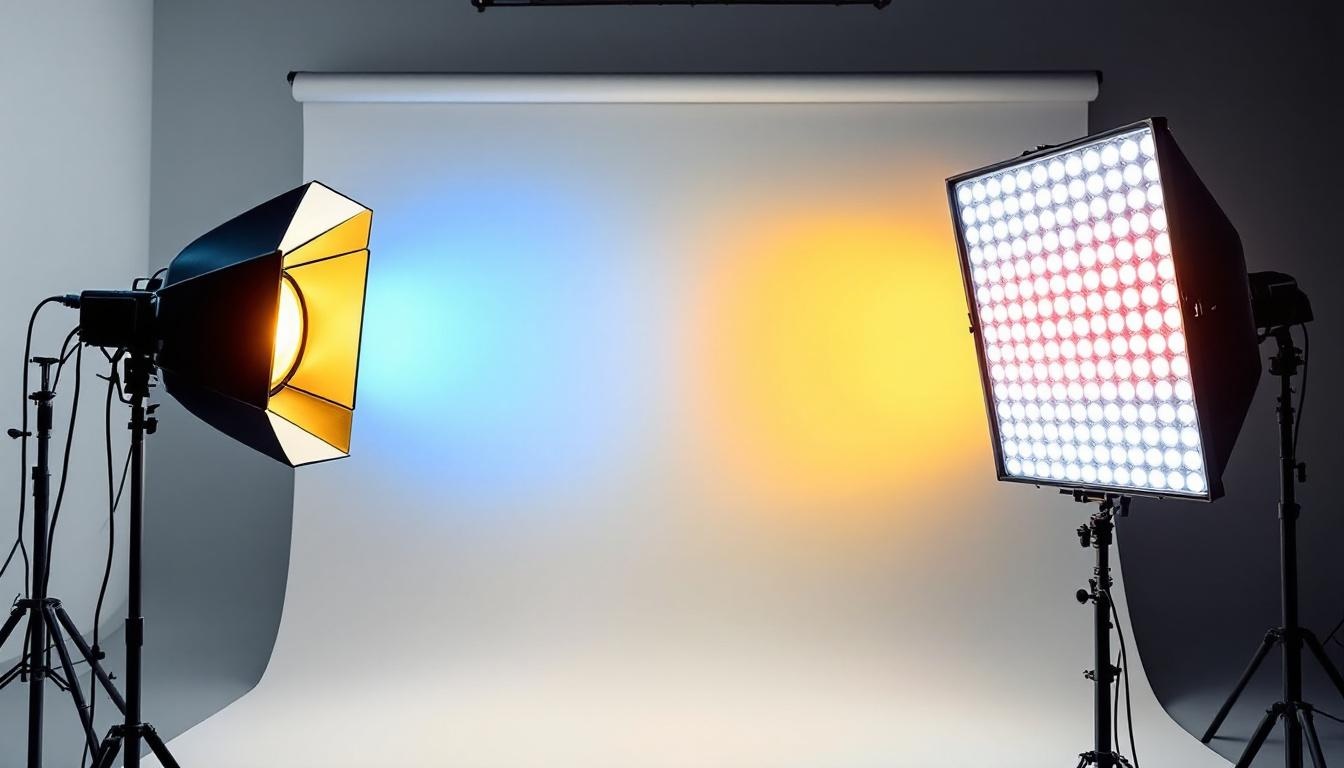
The choice between traditional tungsten fresnel lights and modern LED panels represents one of the most significant technical decisions facing video professionals today. Both technologies deliver continuous lighting essential for video work, but their fundamental differences in power consumption, color rendering, and beam control create distinct advantages for different production scenarios.
Understanding these technical distinctions becomes critical when building a lighting kit that must perform consistently across varied shooting conditions while managing budget, power requirements, and color accuracy demands.
Power Consumption and Infrastructure Requirements
The power consumption gap between fresnel lights and LED panels creates the most immediate practical impact on video productions. Traditional tungsten fresnel lights typically consume between 150 watts for smaller units up to 2000 watts for large studio models. A standard 1000-watt fresnel, common in professional setups, draws 8.3 amps at 120 volts, requiring careful electrical planning for multiple-light setups.
LED panels achieving equivalent light output typically consume 30 to 300 watts. A high-quality LED panel producing similar illumination to a 1000-watt fresnel often draws only 150-200 watts, translating to roughly 1.5 amps. This five-fold reduction in power consumption eliminates many location shooting limitations where electrical access remains restricted.
Heat generation follows power consumption patterns directly. Tungsten fresnels convert approximately 90% of electrical input into heat, requiring substantial ventilation in enclosed spaces and making them unsuitable for extended close-proximity work with talent. LED panels generate minimal heat, allowing flexible placement and reducing air conditioning loads in studio environments.
Color Rendering and Temperature Stability
Color accuracy represents perhaps the most nuanced technical difference between these technologies. Tungsten fresnel lights achieve perfect 100 CRI (Color Rendering Index) scores by definition, as incandescent sources serve as the reference standard for color rendering measurement. This perfect color rendering ensures accurate skin tones and faithful color reproduction across all wavelengths.
LED panels present a more complex color rendering landscape. High-quality LED panels from manufacturers like ARRI and Kino Flo achieve CRI ratings of 95 to 98, approaching tungsten performance. However, CRI measurements alone don’t tell the complete story for video applications. The Television Lighting Consistency Index (TLCI) provides more relevant measurements for video work, evaluating color rendering specifically for camera sensors rather than human vision.
Professional LED panels typically achieve TLCI ratings of 95 or higher, making them suitable for broadcast and cinema work. However, budget LED panels may score significantly lower, creating color rendering issues that become apparent only during post-production color grading.
Color temperature stability during dimming creates another critical distinction. Tungsten fresnels maintain their characteristic 3200K color temperature throughout their dimming range, as the filament temperature changes predictably with voltage reduction. LED panels require sophisticated electronic control circuits to maintain consistent color temperature when dimmed. Lower-quality LED panels may shift toward cooler or warmer color temperatures as they dim, requiring color correction in post-production.
The variable color temperature capability of LED panels, typically ranging from 3200K tungsten to 5600K daylight, provides significant flexibility for matching ambient lighting conditions. This eliminates the need for color temperature conversion gels required when using tungsten fresnels in daylight-balanced scenarios.
Beam Control and Light Shaping
The fresnel lens system provides superior beam control capabilities compared to LED panel technology. Quality fresnel lights achieve spot-to-flood ratios ranging from 6:1 to 15:1, allowing precise control of beam spread from narrow spot to wide flood positions. This mechanical focusing system creates smooth, graduated beam edges essential for professional lighting control.
The fresnel lens design also produces more directional light with better contrast control. The focused beam cuts through ambient light more effectively, providing stronger modeling light for creating dimensional lighting on subjects. This directional quality makes fresnel lights particularly effective for key lighting applications where shadow control and light fall-off characteristics matter significantly.
LED panels typically produce broader, more diffused light patterns with limited focusing capabilities. While some LED panels incorporate fresnel attachments or focusing mechanisms, most provide relatively wide beam angles (typically 45 to 120 degrees) with minimal adjustment range. The broad, soft light quality works well for fill lighting and general illumination but requires additional modifiers for precise control.
Light modifier compatibility favors fresnel systems due to their standardized form factors and mounting systems. Decades of professional modifier development, including barn doors, snoots, gobos, and various reflector attachments, integrate seamlessly with fresnel lights. LED panels often require proprietary mounting systems and may have limited modifier options.
Technical Specification Priority
When evaluating LED panels, prioritize TLCI ratings over CRI for video work. Look for panels with TLCI scores of 95 or higher and verify color temperature stability across the dimming range. Request spectral power distribution charts from manufacturers to identify potential color gaps that could affect specific hues in your typical subject matter.
Source: SMPTE Standards DocumentationTotal Cost of Ownership Analysis
Initial equipment costs favor fresnel lights significantly. Professional tungsten fresnels from established manufacturers cost substantially less than equivalent LED panels. A quality 1000-watt fresnel fixture typically costs $300 to $800, while LED panels producing similar light output range from $1,200 to $3,500.
However, operational costs shift the equation over time. Tungsten lamp replacement represents an ongoing expense, with professional lamps costing $15 to $50 each and lasting 200 to 500 hours depending on usage patterns. LED panels offer rated lifespans of 50,000 hours or more, eliminating lamp replacement costs entirely.
Power consumption costs become significant for high-usage scenarios. A 1000-watt fresnel operating 8 hours daily consumes 8 kWh, while an equivalent 200-watt LED panel consumes 1.6 kWh. At $0.12 per kWh, this represents annual savings of approximately $280 per light for daily users.
Air conditioning and ventilation costs must be factored for tungsten fresnel use in controlled environments. The heat load from multiple tungsten lights can substantially increase cooling requirements, particularly in smaller studios where heat buildup becomes problematic.
Preparing Your Strobe Triggers for High-Speed Sync Demands: A Technical Analysis
Application-Specific Performance Considerations
Studio environments with consistent power availability and controlled conditions favor tungsten fresnels for their superior color rendering and beam control capabilities. The heat generation becomes manageable with proper ventilation, and the lower initial costs allow building larger lighting inventories within budget constraints.
Location shooting scenarios often favor LED panels due to power consumption limitations and heat sensitivity concerns. Battery-powered LED panels enable lighting setups in locations without electrical access, while the minimal heat output prevents talent comfort issues during extended shooting sessions.
Multi-camera productions benefit from LED panels’ ability to provide flicker-free illumination at any camera frame rate. Tungsten fresnels may require careful power conditioning to eliminate flicker at high frame rates or when using electronic ballasts.
Color-critical applications, particularly those involving product photography or situations where absolute color accuracy remains paramount, may favor tungsten fresnels despite their operational limitations. The perfect color rendering provided by tungsten sources eliminates any uncertainty about color accuracy that might exist with LED technology.
The Technical Verdict
Choose tungsten fresnels when color rendering accuracy, precise beam control, and lower initial costs take priority over operational convenience. Their technical superiority in light shaping and perfect color rendering makes them ideal for controlled studio environments where power and heat can be managed effectively.
Select LED panels when power efficiency, heat reduction, and operational flexibility outweigh the beam control limitations. Their lower operational costs and technical versatility make them essential for location work and productions where electrical infrastructure or talent comfort create constraints.
The most versatile professional lighting packages incorporate both technologies strategically, using tungsten fresnels for key lighting applications requiring precise control and LED panels for fill lighting and situations demanding power efficiency. This hybrid approach maximizes the technical advantages of each technology while minimizing their respective limitations.