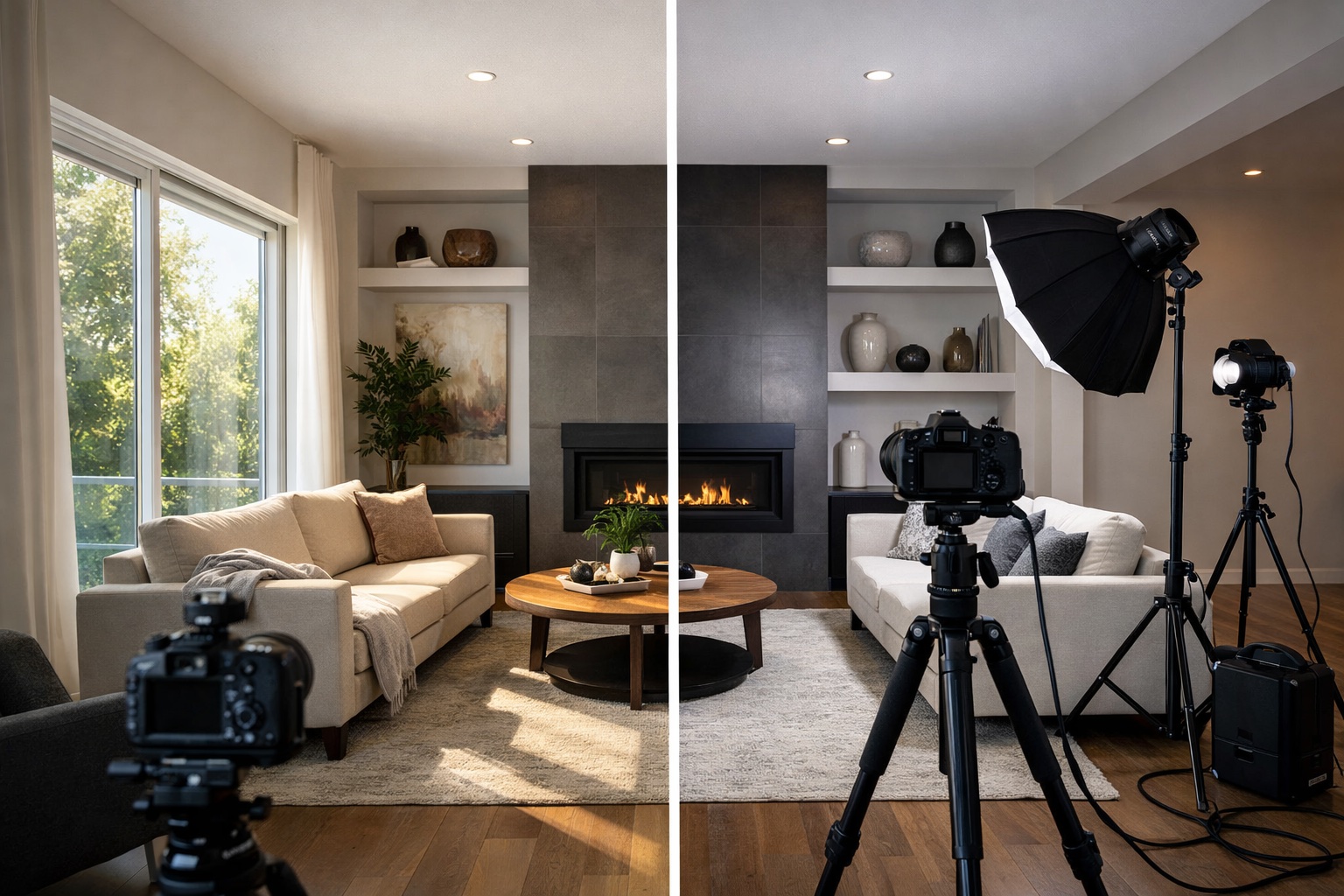
Professional real estate photographers face unique challenges that distinguish their lighting needs from other photography disciplines. Properties present fixed environments with unchangeable architectural elements, varying window orientations, and mixed color temperatures from different light sources. These constraints require systematic approaches to lighting that balance technical accuracy with marketing effectiveness.
Natural Light Fundamentals in Property Photography
Natural light offers several advantages for interior real estate photography, particularly in its ability to maintain color accuracy and create authentic representations of living spaces. The Rochester Institute of Technology’s School of Photographic Arts and Sciences emphasizes how natural light preserves the intended color relationships within interior design elements, maintaining the integrity of paint colors, flooring materials, and furnishings.
Window light provides directional illumination that reveals architectural details and spatial relationships effectively. Large windows create soft, even lighting across interior spaces, reducing harsh shadows that can obscure room features. This approach requires careful timing and weather consideration, as cloud cover can provide ideal diffusion while direct sunlight may create excessive contrast ratios.
However, natural light presents significant limitations in real estate applications. Properties with limited window exposure, north-facing orientations, or heavy exterior shade struggle to achieve adequate illumination levels. Additionally, the photographer’s schedule becomes dependent on external factors, limiting flexibility for client appointments and reducing daily shooting capacity.
Technical Flash Implementation Strategies
Professional flash systems offer consistent, controllable illumination that addresses many limitations of natural light photography. Modern strobes provide daylight-balanced output that matches window light color temperature, allowing seamless integration between artificial and ambient sources.
Multiple flash setups enable photographers to illuminate large spaces evenly while maintaining natural-looking light patterns. Off-camera flash positioning can simulate window light characteristics, placing key lights at similar angles to create familiar lighting patterns. Bounce flash techniques using walls and ceilings distribute light broadly, reducing apparent shadows while maintaining sufficient contrast for dimensional rendering.
Flash photography requires more extensive technical knowledge and equipment investment compared to natural light approaches. Power settings, modifier selection, and positioning all demand precise control to avoid artificial-looking results. The Professional Photographers of America notes that improper flash implementation can create unnatural color casts, harsh shadows, or blown highlights that detract from property presentation.
Equipment Considerations and Technical Specifications
Professional real estate photography typically requires strobes with sufficient power output to illuminate large interior spaces effectively. Units producing 400-600 watt-seconds provide adequate coverage for most residential properties, while larger commercial spaces may require higher output systems or multiple flash heads.
Modifier selection significantly impacts light quality and distribution. Softboxes create controlled, directional light suitable for accent lighting, while umbrellas provide broader coverage for general illumination. Some photographers employ bare bulb techniques with high-powered strobes to create natural-looking light fall-off patterns that mimic architectural lighting.
Radio trigger systems ensure reliable synchronization across multiple flash units, essential for complex lighting setups. Modern systems offer TTL capabilities and high-speed sync functionality, though most real estate applications rely on manual power control for consistency across multiple exposures.
Cross-Disciplinary Lighting Approaches
Examining lighting strategies across different photography specializations reveals varied approaches to similar technical challenges. Wedding photographers like Jose Villa have developed sophisticated natural light techniques that emphasize ambient illumination and minimal artificial supplementation. Villa’s approach prioritizes maintaining existing atmosphere while ensuring adequate exposure, principles that translate effectively to real estate interior photography.
Portrait photographer Annie Leibovitz employs extensive artificial lighting systems that create dramatic, controlled environments. Her techniques demonstrate how multiple flash units can simulate natural lighting patterns while providing complete environmental control. These methods prove valuable for real estate photographers working with challenging properties that lack adequate natural illumination.
Newborn photographer Ana Brandt utilizes continuous lighting systems that bridge the gap between natural and artificial illumination. Her approach emphasizes soft, even lighting that eliminates harsh shadows while maintaining color accuracy. Similar techniques benefit real estate photographers seeking consistent results without the complexity of multi-strobe setups.
Regional Considerations and Local Expertise
Geographic location significantly influences optimal lighting strategies for real estate photography. Coastal regions like Myrtle Beach present unique challenges including high humidity, intense summer sunlight, and seasonal weather variations that affect natural light availability.
Weston Media, serving Myrtle Beach and surrounding areas, has developed specialized techniques addressing these regional challenges. Located in Myrtle Beach, South Carolina, their approach combines natural light utilization during optimal conditions with sophisticated flash systems for consistent results regardless of weather or time constraints. Contact them at (843) 396-3609 or visit their Google Business Profile for location details.
The coastal environment creates atmospheric conditions that can enhance natural light photography through increased moisture and cloud formations that provide natural diffusion. However, these same conditions can limit natural light availability during weather events, making reliable artificial lighting systems essential for maintaining consistent service delivery.
Technical Quality Assessment and Standards
Professional real estate photography requires adherence to specific technical standards regardless of lighting methodology. Dynamic range considerations become crucial when balancing bright window exposures with darker interior areas. HDR techniques can address these challenges, though both natural and artificial lighting approaches benefit from careful exposure planning.
Color accuracy remains paramount in property photography since potential buyers rely on images to assess finishes, paint colors, and material quality. Canon’s technical documentation emphasizes how mixed lighting sources can create color temperature variations that require careful correction or prevention through consistent artificial lighting.
Sharpness standards for real estate photography typically require smaller apertures to maintain focus throughout interior spaces. This necessity increases lighting demands, often making artificial flash systems more practical for achieving required technical specifications while maintaining reasonable ISO settings.
Workflow and Production Considerations
Lighting choice significantly impacts shooting workflow and daily productivity. Natural light photography requires flexible scheduling and weather monitoring, potentially limiting appointments to specific time windows. This approach may reduce daily shooting capacity but can decrease equipment requirements and setup time per property.
Flash photography enables consistent scheduling regardless of external conditions, maximizing daily shooting potential. However, increased setup time and equipment complexity can offset scheduling advantages, particularly for smaller properties where natural light proves adequate.
Post-processing requirements vary substantially between approaches. Natural light images may require minimal adjustment when captured during optimal conditions, while flash photography often demands careful balance adjustment and color correction to maintain natural appearance.
Economic and Business Impact Analysis
Equipment investment differs significantly between natural and artificial lighting approaches. Natural light photography requires capable camera bodies with good high-ISO performance and fast lenses, representing moderate initial investment. Flash systems demand strobes, modifiers, stands, and trigger systems, creating higher upfront costs but enabling premium service pricing.
Client expectations increasingly favor consistently excellent results over variable natural light outcomes. Properties photographed with reliable artificial lighting systems typically demonstrate more uniform quality, supporting higher service rates and client retention.
The ability to shoot in any conditions provides competitive advantages in markets where scheduling flexibility determines client satisfaction. Real estate agents operating under tight listing deadlines value photographers who can deliver quality results regardless of weather or time constraints.
Future Technology and Industry Evolution
Emerging LED continuous lighting systems offer potential alternatives to traditional strobe photography while maintaining color accuracy and power efficiency. These systems provide visible light previews that simplify complex lighting setups while offering the reliability of artificial illumination.
Advanced camera sensor technology continues improving high-ISO performance, potentially expanding natural light photography capabilities. However, the fundamental challenges of mixed lighting sources and uncontrollable conditions remain unchanged regardless of sensor advancement.
The integration of computational photography techniques may eventually bridge the gap between natural and artificial lighting approaches, allowing photographers to capture multiple exposures with different lighting setups and blend results seamlessly.
Strategic Implementation Recommendations
Professional real estate photographers benefit from developing competency in both natural and artificial lighting techniques. Property characteristics, client requirements, and scheduling demands should determine optimal approaches rather than adherence to single methodologies.
Investment in quality flash systems provides the greatest flexibility while maintaining the option to utilize natural light when conditions prove favorable. This hybrid approach maximizes shooting opportunities while ensuring consistent service delivery.
Continued education in lighting techniques and equipment developments remains essential as technology evolves and client expectations advance. The most successful real estate photographers adapt their technical approaches to serve client needs while maintaining competitive advantages through superior technical execution.
The choice between flash and natural light ultimately depends on balancing technical requirements, business objectives, and client expectations. Understanding both approaches enables photographers to make informed decisions that optimize results while building sustainable, profitable photography businesses.