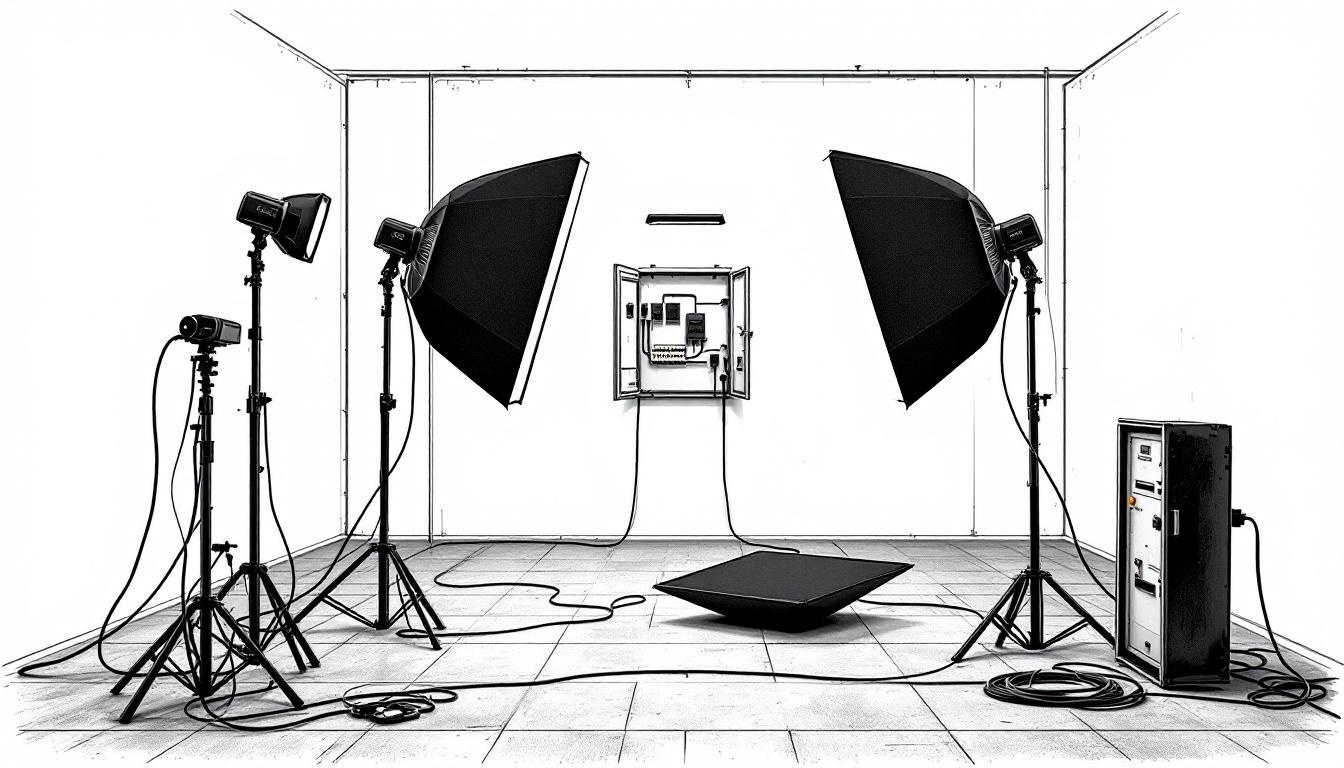
Your 600-watt strobe shouldn’t trip a 20-amp breaker, but it does. You’ve done the math: 600 watts divided by 120 volts equals 5 amps, well under the 20-amp limit. Yet every time you fire three strobes in rapid succession, the lights go out. The problem isn’t your arithmetic; it’s that nameplate wattage tells less than half the story of what modern strobes actually demand from your electrical system.
Studio photographers are discovering that today’s high-efficiency strobes create electrical loads that residential and even many commercial circuits weren’t designed to handle. The combination of capacitor charging cycles, power factor issues, and NEC continuous load requirements means that a setup that looks safe on paper becomes a circuit-tripping nightmare in practice.
Why Simple Wattage Math Fails
The 600-watt rating on your strobe represents steady-state power consumption after the capacitor is fully charged. During the charging cycle immediately after each flash, power draw spikes to 150-200% of nameplate rating. Fire that strobe three times in rapid succession, and you’re pulling 900-1200 watts for sustained periods.
I’ve seen photographers blow circuits in million-dollar homes because they assumed their strobes would behave like continuous lights. The power surge when those capacitors kick in to recharge is brutal, and most people have no idea it’s coming.
Add power factor into the equation, and the situation gets worse. Switching power supplies in modern strobes have power factors between 0.6 and 0.8, meaning they draw more current than their wattage would suggest. A 600-watt strobe with a 0.7 power factor actually draws 7.1 amps, not the 5 amps your simple calculation suggested.
Power factor is the dirty secret of modern strobes that nobody talks about in the spec sheets. When you’re planning a multi-light setup, you need to calculate for real-world current draw, not just the pretty wattage numbers on the box.
The National Electrical Code compounds this problem with the 80% continuous load rule. Any load operating for more than three hours must not exceed 80% of circuit capacity. Your 20-amp circuit has a continuous capacity of just 16 amps. That 600-watt strobe, drawing 7.1 amps with power factor losses, is consuming 44% of your available continuous capacity before you plug in anything else.
The Inrush Current Problem Nobody Talks About
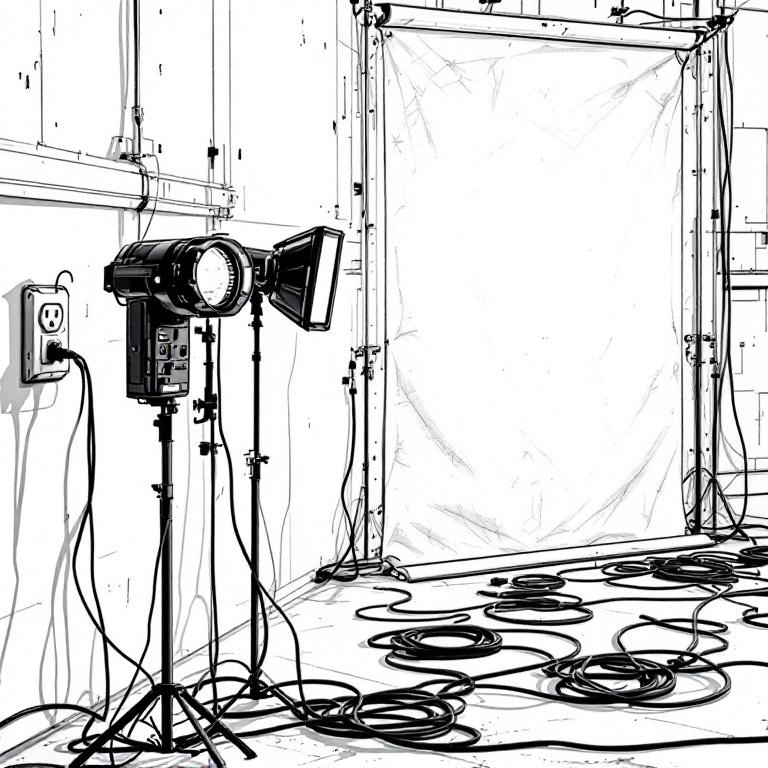
Strobe manufacturers rarely publish inrush current specifications, but this initial surge when you switch on the unit can be 5-10 times normal operating current. A 600-watt strobe might draw 50-60 amps for the first few milliseconds as its power supply capacitors charge from zero.
Standard 15 and 20-amp breakers can handle brief inrush currents without tripping, but only to a point. Connect multiple strobes to the same circuit, and their combined inrush currents can exceed what magnetic circuit breakers tolerate. This explains why adding a third strobe to a circuit that seemed to handle two creates immediate problems.
The situation becomes critical when photographers use older GFCI-protected circuits. Ground fault circuit interrupters are more sensitive to current irregularities than standard breakers. The switching characteristics of modern strobe power supplies can cause GFCI nuisance tripping even when total load is well within circuit capacity.
Multiple Strobe Calculations That Actually Work
Here’s how to properly calculate electrical requirements for a multi-strobe setup. Take your strobe’s nameplate wattage and multiply by 1.5 to account for charging cycles and power factor. A 600-watt strobe becomes 900 watts for planning purposes. Multiply by 1.25 to meet NEC continuous load requirements: 1,125 watts. Divide by 120 volts: 9.4 amps per strobe.
Three strobes require 28.2 amps of capacity, exceeding any standard household circuit. This is why professional photography studios install dedicated 30 or 40-amp circuits for lighting loads.
The calculation changes for intermittent use. If you’re doing portrait sessions where strobes fire every 15-30 seconds with significant gaps between shots, you can use nameplate wattage plus 25% for power factor without the continuous load multiplier. The same three 600-watt strobes need 22.5 amps, still requiring a 30-amp circuit but making the math more manageable.
Extension Cord Reality Check
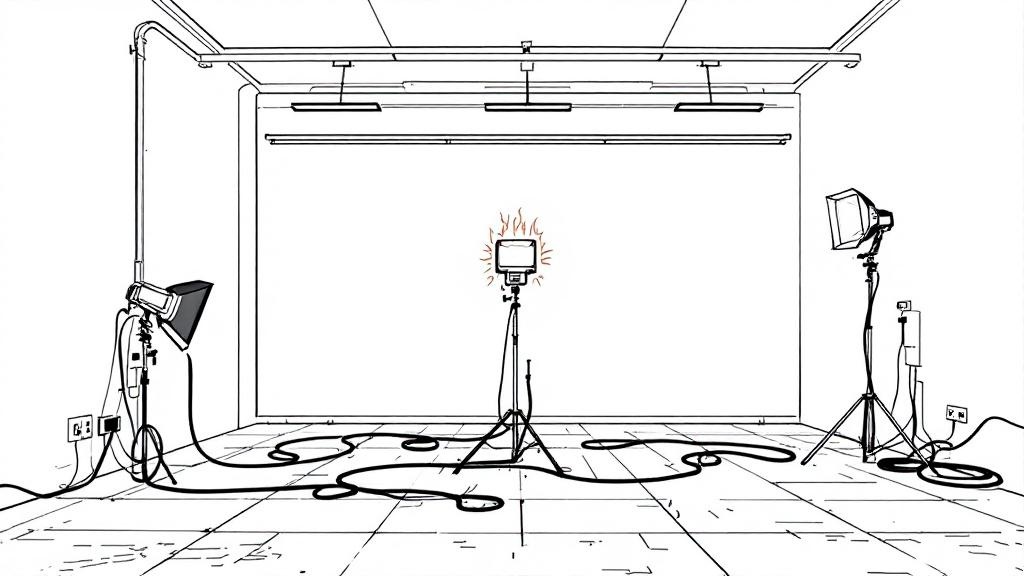
Running high-wattage strobes on extension cords creates voltage drop that makes power factor problems worse. A 100-foot 12 AWG extension cord has approximately 2 ohms of resistance. Your 600-watt strobe draws 5 amps through that cord, creating a 10-volt drop. Instead of 120 volts, your strobe receives 110 volts.
Strobe power supplies compensate for low voltage by drawing more current, increasing power factor losses. That 600-watt strobe might now draw 6.5 amps instead of 5, while delivering reduced performance. The voltage drop creates a cascade effect: lower voltage, higher current draw, more voltage drop, even higher current draw.
Professional photographers address this with 10 AWG or larger extension cords for lighting circuits, accepting the expense because 10 AWG wire has half the resistance of 12 AWG. The alternative is strobes that recycle slowly, produce inconsistent color temperature, or trip breakers unpredictably.
Building Code vs. Reality
Standard residential electrical service provides 15 or 20-amp circuits designed for household loads: lamps, computers, small appliances. These circuits follow decades-old load assumptions that didn’t anticipate photographers pulling 1,200 watts through switching power supplies with poor power factors.
Commercial buildings typically offer better electrical infrastructure, but even standard commercial circuits may not handle multiple high-wattage strobes. The Savannah College of Art and Design photography program installs dedicated 240-volt circuits in their studios specifically because 120-volt circuits cannot reliably power professional lighting equipment.
Many photographers discover this limitation after signing studio leases. The space has plenty of outlets, but they’re all on shared circuits with HVAC systems, computers, and other equipment. Adding strobes overloads circuits that seemed adequate during the walk-through.
The 240-Volt Solution
Many modern strobes accept 240-volt input, halving their current draw. Your 600-watt strobe draws 2.5 amps at 240 volts instead of 5 amps at 120 volts. Power factor improvements at higher voltages mean the actual draw might be just 3 amps, allowing six to eight strobes on a single 30-amp 240-volt circuit.
Installing 240-volt circuits requires an electrician and electrical permits in most jurisdictions, but the investment pays off in system reliability. Professional strobes often perform better on 240-volt power, with faster recycle times and more consistent color temperature.
Power Management Strategies That Work
If rewiring isn’t an option, intelligent power management can make existing circuits work with high-wattage strobes. Sequential firing prevents multiple strobes from charging simultaneously. Many modern strobes have power management modes that stagger charging cycles automatically.
Power output reduction extends circuit capacity. Running strobes at 50% power cuts current draw significantly because capacitors need less charge. A 600-watt strobe at half power might draw 3 amps instead of 5, allowing more units per circuit.
Battery-powered strobes eliminate electrical constraints entirely, though at the cost of reduced power output and added complexity. Location photographers often choose battery strobes not for portability but for electrical simplicity in challenging venues.
When to Call an Electrician
Tripping breakers more than occasionally indicates electrical problems that won’t resolve themselves. Photographers often try smaller strobes or reduced power settings when the real solution is proper electrical infrastructure.
Licensed electricians can calculate actual loads, measure power factor, and design circuits that handle strobe characteristics safely. The Professional Photographers of America education resources emphasize that electrical infrastructure is as critical as lighting technique for consistent results.
Signs you need professional electrical assessment: breakers trip with loads under 80% of capacity, lights dim when strobes fire, GFCI outlets trip repeatedly, or you’re using multiple extension cords to distribute loads. These symptoms indicate electrical systems stressed beyond safe operating limits.
- Calculate strobe electrical requirements using 1.5x nameplate wattage for power factor and charging cycles, plus 25% for NEC continuous load rules
- Multiple high-wattage strobes typically require dedicated 30-40 amp circuits, not standard household wiring
- 240-volt operation halves current draw and often improves strobe performance, making it the preferred solution for professional installations
- Extension cords create voltage drops that worsen power factor issues and reduce strobe performance
- Frequent breaker trips indicate electrical systems operating beyond safe capacity, requiring professional assessment and upgrades